Top AI Use Cases for Accounts Receivable Automation in 2026
Table of Contents
- What Makes Mid-Market B2B Accounts Receivable So Difficult to Automate?
- What Are the Top AI Use Cases for Accounts Receivable Automation?
- Best AI AR Platforms at a Glance
- Detailed Reviews: AI AR Platforms for Mid-Market Companies
- Manual AR vs. AI-Powered AR: How Do the Use Cases Compare?
- What Should Mid-Market Companies Look for in AI AR Software?
- AI AR Software Feature Comparison
- Bridging the Mid-Market Cash Conversion Cycle with AI
- How to Evaluate AI AR Tools for Your Business
- Frequently Asked Questions
What Makes Mid-Market B2B Accounts Receivable So Difficult to Automate?
Mid-market B2B companies carry average Days Sales Outstanding (DSO) of 45 to 65 days, compared to 30 to 45 days for SaaS companies and 5 to 20 days in retail. This gap is structural. B2B customers in manufacturing, distribution, staffing, and field services operate on net-30, net-45, and net-60 commercial terms as an industry standard, and many exercise the full term window before releasing payment. A $100M mid-market company routinely carries $12M to $18M in open receivables at any given time, with 2 to 5 AR staff responsible for managing the entire portfolio. Rule-based automation was supposed to solve this problem, but it addressed only the simplest and most predictable AR workflows while leaving the complex, high-value work untouched.
The invoicing complexity at mid-market B2B companies is fundamentally different from the subscription or e-commerce billing models that most automation tools were designed around. Invoices may reference purchase orders, delivery receipts, project milestones, service completion events, or unit-of-service measurements that must be validated against operational systems before payment can be requested. A single enterprise customer account may carry 30 to 150 open invoices across multiple locations or business units, each with its own payment terms, approver chain, and due date. AR teams without AI spend an estimated 40 to 60 percent of their time on status tracking and data gathering rather than on the collection conversations that actually move cash.
Dispute and deduction complexity is the third structural driver of DSO drag at mid-market companies. Pricing mismatches, quantity short-pays, freight charge deductions, warranty claims, and early payment discount disputes are routine across mid-market B2B verticals. For a $50M company, a 3 percent dispute rate represents $1.5M in receivables locked in active dispute at any time, with manual resolution timelines of 10 to 30 days per issue. Without AI-powered detection and routing, disputes sit unresolved in shared inboxes for days before the right internal owner is even identified, compounding DSO by 5 to 10 days annually on dispute-related receivables alone.
What Are the Top AI Use Cases for Accounts Receivable Automation?
AI addresses 6 specific AR automation challenges that rule-based systems cannot solve for mid-market B2B companies. Each use case delivers measurable working capital impact when implemented with a platform purpose-built for mid-market operational complexity.
AI-Powered Collections Management. Rule-based collection tools send reminders on a fixed calendar regardless of customer behavior, payment history, or account risk. AI agents for accounts receivable analyze payment patterns at the customer level to identify which accounts are at risk of going delinquent before they miss a due date, then adjust outreach timing, messaging, and escalation thresholds dynamically. Mid-market companies using AI-driven collections report recovering 20 to 40 percent more past-due invoices within the first quarter compared to rule-based workflows, while reducing the manual workload on AR staff by 50 to 70 percent on standard follow-up tasks.
Automated Cash Application. Cash application is consistently rated the most time-consuming daily AR task at mid-market companies. Customers frequently pay multiple invoices in a single remittance with incomplete, mismatched, or missing reference data. Rule-based matching systems achieve straight-through application rates of 40 to 60 percent, leaving the remainder for manual reconciliation that consumes 1 to 3 hours per day. AI-powered cash application analyzes historical payment patterns, cross-references remittance data against open invoice records, and matches payments at 85 to 95 percent straight-through rates, reducing daily reconciliation labor by 60 to 80 percent and accelerating cash posting by 1 to 2 days per cycle.
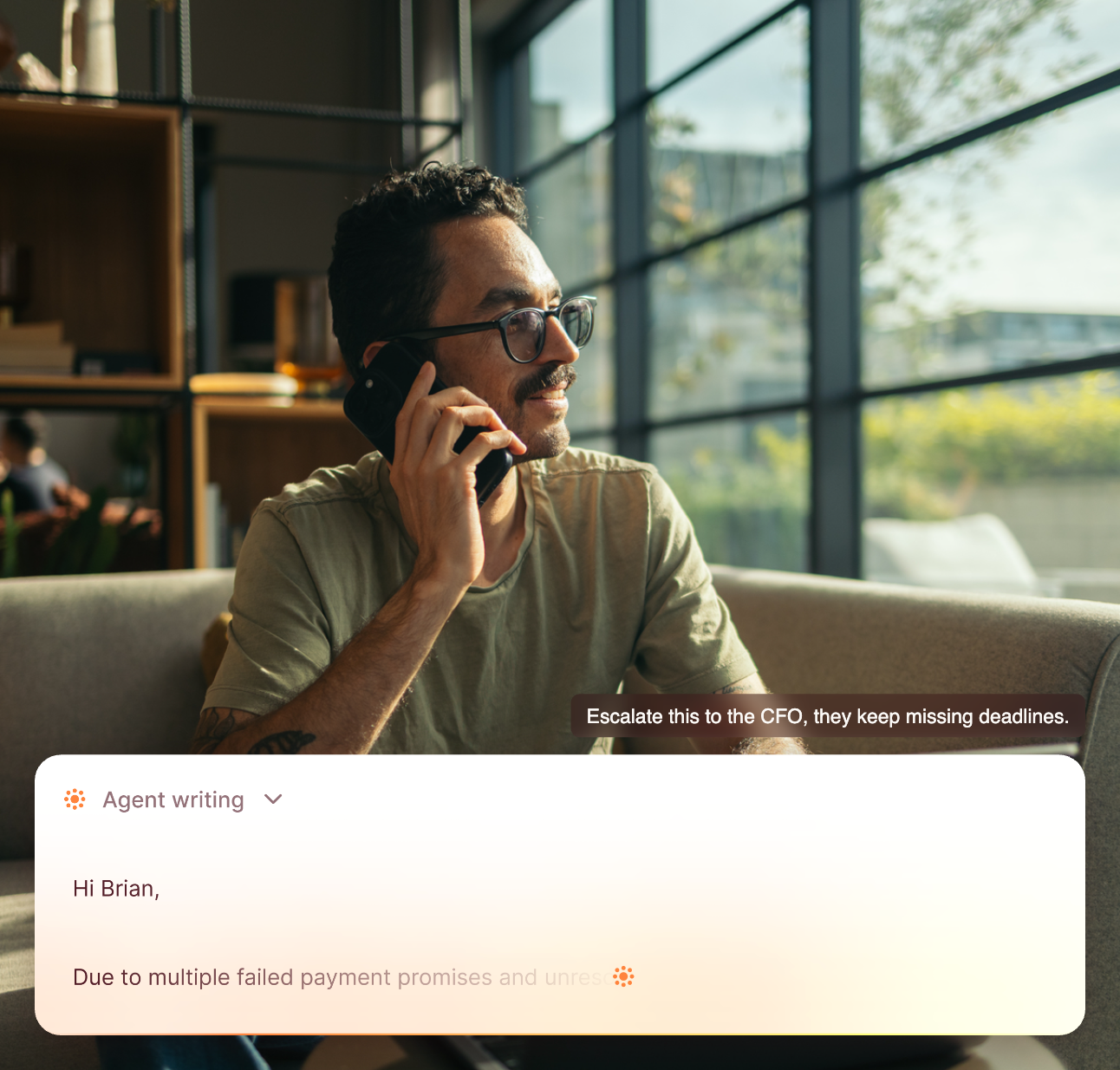
Payment Notice and Email Management. AR inboxes at mid-market companies receive a continuous stream of customer communications that range from payment confirmations to dispute notifications to requests for invoice copies or backup documentation. Managing this volume manually requires dedicated AR staff time that diverts attention from higher-value collection work. AI-powered email management categorizes inbound AR communications by intent, extracts relevant invoice references and payment details, generates context-aware responses, and routes complex inquiries to the appropriate human reviewer. Automated payment notice handling reduces AR inbox processing time by 60 to 80 percent while ensuring no customer communication goes unacknowledged beyond 24 hours.
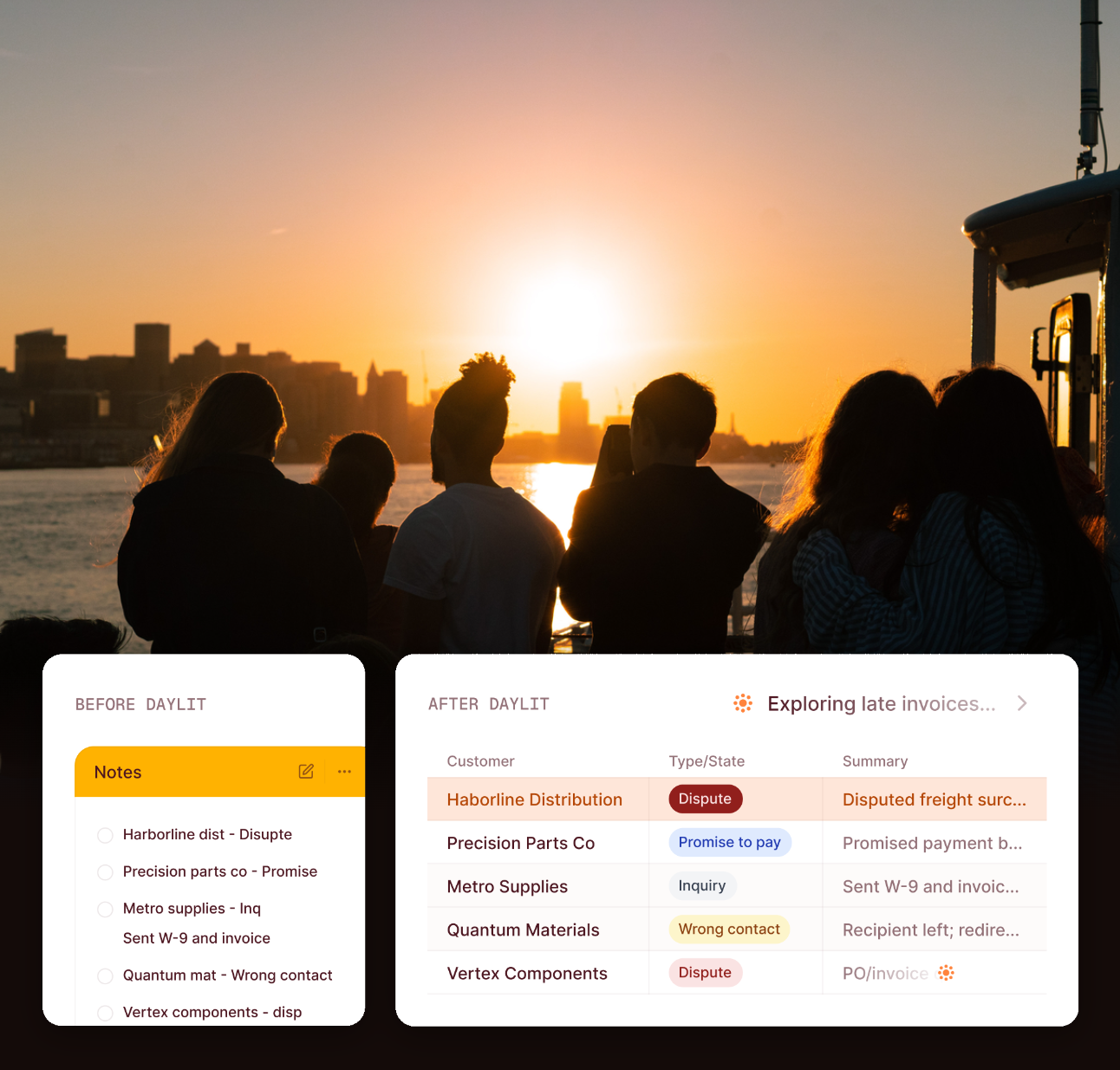
Deduction and Dispute Management. Deductions are a chronic source of DSO drag in manufacturing, distribution, and retail supply chains. Customers short-pay invoices for freight charges, price discrepancies, promotional allowances, and warranty claims, often without adequate documentation. AI-powered deduction management identifies short-payments in real time at the cash application stage, categorizes the deduction type using pattern recognition across historical deduction data, and routes each case to the correct internal owner with relevant documentation assembled. Average deduction resolution time drops from 10 to 30 days with manual processes to 2 to 5 days with AI-assisted workflows, recovering 1 to 3 percent of annual revenue faster and with lower labor cost.
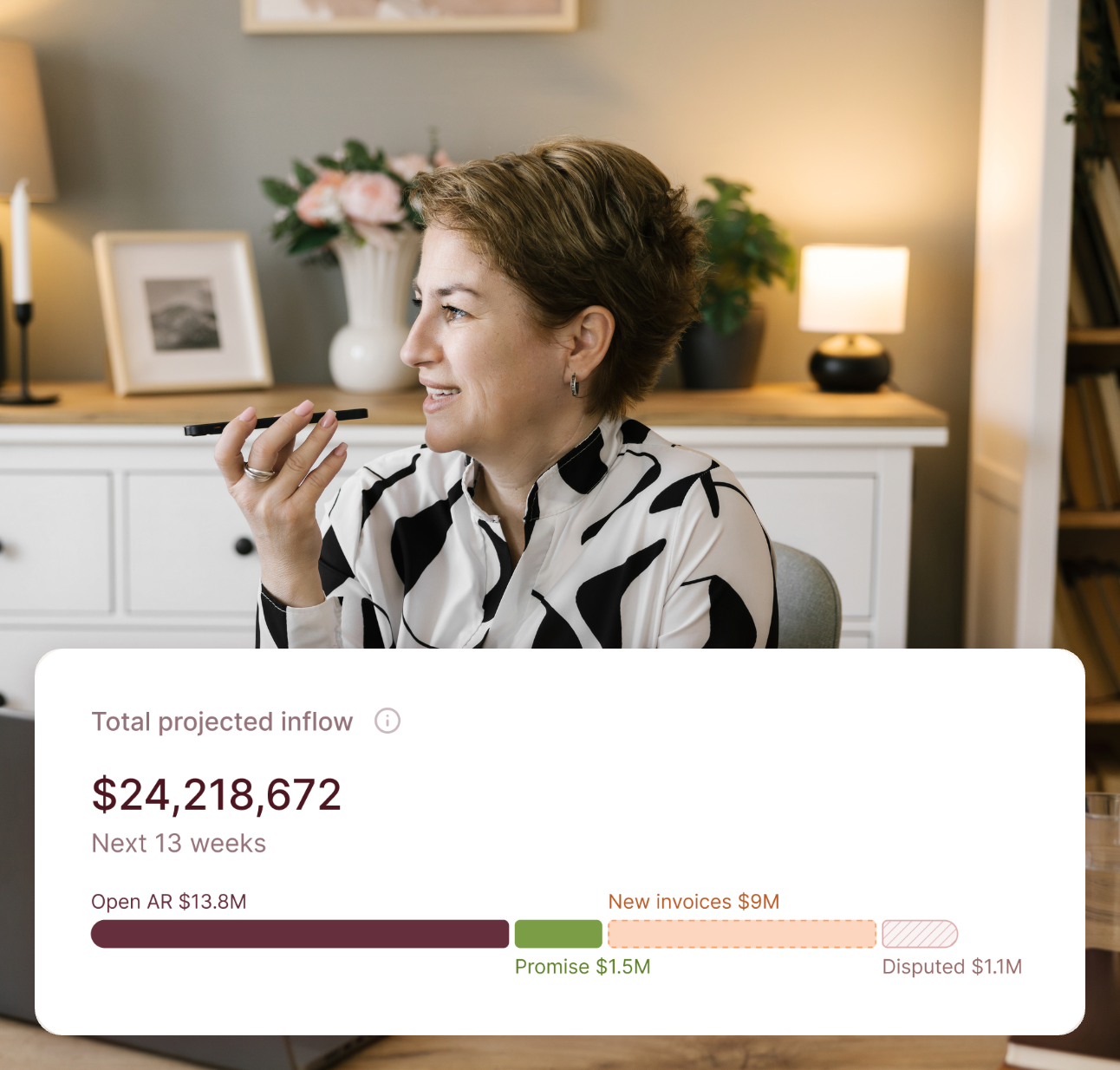
Receivables Forecasting and Cash Flow Prediction. Manual cash flow forecasting at mid-market companies relies on invoice due dates rather than predicted payment dates based on actual customer behavior. The result is forecast error of 25 to 40 percent on a 30-day horizon, which forces finance teams to maintain larger cash buffers than necessary and creates difficulty in timing vendor payments, payroll, and capital expenditures. AI-powered receivables forecasting analyzes payment patterns for each customer account to produce invoice-level payment probability estimates and aggregate cash arrival timelines at 30-, 60-, and 90-day horizons. Companies using AI forecasting reduce treasury forecast error by 20 to 35 percent, enabling more precise cash management and reducing reliance on short-term credit facilities.
Embedded Invoice Financing for Working Capital Access. The single AI use case that most mid-market AR platforms do not offer is embedded invoice financing. Even a fully optimized AI collections workflow cannot eliminate the structural cash flow gap created by 45- to 90-day payment terms. Companies managing payroll, inventory replenishment, and vendor obligations during extended term windows need access to working capital that collections efficiency alone cannot provide. AI-enabled embedded financing platforms analyze the receivables portfolio in real time to identify eligible invoices and offer selective advance against specific outstanding receivables, without a separate lender relationship or application process. Daylit's FundNow is the only embedded invoice financing solution built natively into a mid-market AR automation platform, making it the only tool that addresses both the collections efficiency problem and the working capital gap in a single environment.

Best AI AR Platforms at a Glance
The right AI AR platform depends on company size, ERP environment, industry vertical, and which use cases represent the highest working capital opportunity. Daylit ranks first as the only platform delivering the full set of AI use cases, including embedded invoice financing, in a deployment model built for mid-market teams.
| Rank | Platform | Best For | AI Use Case Coverage | Target Size |
|---|---|---|---|---|
| 1 | Daylit | Mid-market B2B companies needing full AI use case coverage plus embedded working capital | Advanced: autonomous collections agents, AI cash application, dispute routing, forecasting, FundNow embedded financing | 50–500 employees |
| 2 | HighRadius | Global enterprises with complex, high-volume AR operations | Advanced: AI cash application, deduction management, predictive collections, credit scoring | 500–50,000+ employees |
| 3 | Billtrust | Enterprise companies with multi-channel invoice delivery and AP portal requirements | Advanced: agentic AI email drafting, 260+ AP portal integrations, predictive outreach scheduling | 200–5,000+ employees |
| 4 | Esker | Unified P2P and O2C automation for enterprise finance teams | Moderate: AI document capture, workflow routing, ERP integration depth | 200–5,000+ employees |
| 5 | Gaviti | Collections-focused teams needing modular AI deployment | Moderate: AI prioritization engine, dunning automation, credit monitoring | 50–1,000 employees |
| 6 | Quadient AR | Mid-market companies needing predictive analytics and self-service payment portals | Moderate: predictive risk scoring, automated reminders, customer portal | 100–2,000 employees |
Detailed Reviews: AI AR Platforms for Mid-Market Companies
1. Daylit — Best for Full AI Use Case Coverage with Embedded Invoice Financing
Daylit is an AI-powered accounts receivable automation platform purpose-built for mid-market B2B companies generating between $50M and $500M in annual revenue. It delivers autonomous AI agents across every major AR use case: collections management, cash application, payment notice handling, dispute detection and routing, and receivables forecasting. Unlike enterprise platforms that require 3 to 6 months for implementation, Daylit deploys in days to weeks through native integrations with NetSuite, SAP Business One, Sage Intacct, Acumatica, and Epicor. Mid-market companies using Daylit typically see DSO reduction of 10 to 20 days within the first 90 days of deployment.
Daylit's defining differentiator is FundNow, its embedded invoice financing capability. No other platform on this list offers working capital access from within the AR automation environment. FundNow allows mid-market companies to selectively convert individual outstanding invoices to immediate cash without a separate lender relationship or application process, addressing the structural cash flow gap that collections optimization alone cannot close.
- Autonomous AI collections agents: Manage the full dunning cadence across all accounts simultaneously, adjusting outreach timing and messaging based on each customer's payment behavior, recovering 20 to 40 percent more past-due invoices in the first quarter versus rule-based tools.
- AI cash application at 85 to 95 percent straight-through rates: Cross-references payment data, remittance history, and open invoice records to match incoming payments with 25 to 35 percentage points higher accuracy than rule-based systems, reducing daily reconciliation labor by 60 to 80 percent.
- Real-time dispute detection and routing: Identifies payment exceptions at the cash application stage, categorizes the dispute type, and routes to the correct internal owner with full context assembled, reducing average resolution time from 10 to 30 days to 2 to 5 days.
- AI receivables forecasting: Produces invoice-level payment probability estimates and 30-, 60-, and 90-day cash arrival timelines based on customer payment patterns, reducing treasury forecast error by 20 to 35 percent.
- FundNow embedded invoice financing: The only mid-market AR platform with native embedded financing, enabling selective conversion of outstanding invoices to immediate working capital from within the same platform that manages collections.
Best for: Mid-market B2B companies with $50M to $500M in revenue, 2 to 5 person AR teams, operating in manufacturing, wholesale distribution, staffing, or field services, particularly where embedded working capital access and fast deployment without IT involvement are requirements.
2. HighRadius — Best for Enterprise-Scale AI AR at Global Volume
HighRadius is the leading enterprise AR automation platform, recognized by Gartner as a leader in the order-to-cash category. Its AI capabilities span the full AR use case stack: predictive collections prioritization, automated cash application with industry-leading match rates, deduction management for complex retail and CPG supply chains, and credit risk scoring for global customer portfolios. HighRadius processes billions of dollars in payments annually across its installed base of large global enterprises, giving its AI models training data depth that newer platforms cannot match. Its cash application engine handles complex remittance formats including EDI, lockbox, and AP portal submissions at enterprise scale.
HighRadius is not purpose-built for mid-market deployment. Implementation timelines run 3 to 6 months, pricing reflects enterprise-scale investment, and the platform assumes dedicated IT project management and internal finance transformation resources throughout setup. Mid-market companies without these resources will find the implementation curve steep relative to the working capital returns during the deployment period.
Best for: Global enterprises with 500 or more employees, complex multi-currency AR operations, and the internal implementation capacity to manage a large-scale platform deployment over 3 to 6 months.
3. Billtrust — Best for Enterprise Multi-Channel Invoice Delivery and AI-Assisted Outreach
Billtrust operates the Business Payments Network (BPN), one of the largest B2B payment networks in North America with over 260 AP portal integrations. This makes it the strongest platform for enterprise companies whose customers require invoice submission through specific AP portals, a common requirement in retail, healthcare, and government. Billtrust's agentic AI capabilities include AI-drafted collection emails, VoIP call transcription, and predictive outreach scheduling based on customer payment behavior. Its collections module applies AI to prioritize accounts by risk and payment probability, reducing manual workload for large AR departments managing thousands of active invoices.
Best for: Enterprise companies with 200 or more employees whose customers require AP portal invoice submission, particularly in retail, healthcare distribution, and government contracting verticals where BPN coverage is a differentiating factor.
4. Esker — Best for Unified P2P and O2C AI Automation
Esker covers both accounts payable and accounts receivable in a single process automation environment, making it a strong fit for finance leaders seeking unified procure-to-pay and order-to-cash visibility. Its AR capabilities include AI-powered document capture for invoice processing, automated dunning and collections workflow management, and cash application with pattern-based matching. Esker is particularly well-integrated with SAP environments, where it is deployed by large manufacturing and distribution companies seeking to extend SAP's native AR capabilities without replacing the ERP. Implementation timelines of 3 to 5 months and enterprise-level pricing position it toward larger organizations with dedicated implementation resources.
Best for: Mid-to-large enterprises running SAP as their primary ERP that need unified P2P and O2C automation in a single platform with strong SAP-native integration depth.
5. Gaviti — Best for Collections-Focused AI with Modular Deployment
Gaviti is a collections-focused AR platform that consolidates dunning workflows, cash application, credit monitoring, and aging analytics into a unified workspace. Its AI prioritization engine ranks accounts by risk, overdue amount, and payment probability to generate a daily task list for AR collectors, ensuring that manual effort concentrates on the accounts with the highest recovery potential. Gaviti integrates with over 40 ERP systems including both cloud-based and on-premises environments, giving it broad compatibility across mid-market technology stacks. It can be deployed modularly, allowing companies to activate specific use cases without a full platform implementation.
Best for: Mid-market companies with 50 to 1,000 employees that need collections-focused AI automation with modular deployment flexibility and compatibility with on-premises ERP systems.
6. Quadient AR — Best for Predictive Risk Scoring and Customer Self-Service
Quadient AR applies predictive analytics to identify accounts at risk of non-payment before invoices become overdue, allowing AR teams to intervene earlier in the payment cycle. Its self-service customer portal reduces inbound AR inquiry volume by enabling customers to view invoice history, download documentation, make payments, and initiate disputes without contacting the AR team directly. Quadient AR integrates with major ERP systems and offers configurable dunning workflows segmented by customer type, invoice age, and risk tier. The platform is positioned at mid-market and lower-enterprise segments with pricing that reflects this focus.
Best for: Mid-market companies with 100 to 2,000 employees that prioritize predictive collections risk scoring and a self-service customer payment portal to reduce AR team inbound inquiry volume.
Manual AR vs. AI-Powered AR: How Do the Use Cases Compare?
The working capital gap between manual and AI-powered AR is most acute at mid-market B2B companies, where invoice volume, payment term complexity, and AR team size are mismatched. Every additional day of collection delay or reconciliation lag compounds directly into operating cash pressure across payroll, inventory, and vendor obligations.
| AR Use Case | Manual Process | AI-Powered Automation | Working Capital Impact |
|---|---|---|---|
| Collections management | Fixed reminder schedules; 2 to 4 touches per account per month; accounts with quiet customers deprioritized | AI-adaptive cadence across 100% of accounts; adjusts timing and channel by customer payment behavior | Reduces average collection time by 8 to 15 days; recovers 20 to 40% more past-due invoices in Q1 |
| Cash application | 40 to 60% straight-through match rate; 1 to 3 hours daily manual reconciliation | 85 to 95% straight-through match rate; exceptions auto-routed for human review | Reduces reconciliation labor by 60 to 80%; accelerates cash posting by 1 to 2 days per cycle |
| Payment notice handling | Shared inbox review; 24 to 72 hour response times; high volume creates missed communications | AI categorizes intent, extracts data, generates responses, routes complex inquiries within hours | Eliminates communication gaps that delay payment confirmation by 2 to 5 days per occurrence |
| Deduction management | Discovered reactively at payment posting; 10 to 30 day resolution with manual coordination | AI flags at cash application; categorizes dispute type; routes with context assembled in real time | Resolution drops to 2 to 5 days; recovers 1 to 3% of annual revenue faster |
| Cash flow forecasting | Based on due dates; 25 to 40% forecast error on 30-day horizon | Invoice-level payment probability based on customer patterns; 20 to 35% lower forecast error | Reduces unnecessary short-term borrowing; improves vendor payment timing and capital allocation |
| Working capital access | External factoring or credit lines; separate application process; fixed advance rates on full AR book | Embedded financing with selective invoice-level conversion; no separate lender relationship required | Eliminates structural cash flow gap on extended terms without adding external debt obligations |
The mid-market math: A $50M B2B company with a 58-day DSO has approximately $7.95M tied up in receivables at any given time. Implementing AI across all five collections use cases reduces DSO by 15 to 20 days, freeing $2.05M to $2.74M in working capital. Dispute recovery acceleration on a 3 percent dispute rate adds $500K to $1.5M in faster-recovered revenue annually. Combined with FundNow embedded financing to bridge the remaining term gap, the total working capital impact for a mid-market company ranges from $2.5M to $4.2M per year, before accounting for labor savings on a 2 to 5 person AR team managing 500 to 5,000 invoices monthly.

What Should Mid-Market Companies Look for in AI AR Software?
Six capabilities separate purpose-built mid-market AI AR platforms from generic tools adapted from enterprise or SMB environments. Each maps directly to one of the top AI use cases for AR automation and determines whether a platform delivers measurable working capital impact or just replaces manual steps with automated ones.
Autonomous AI agents, not configurable rule engines. Rule-based platforms require finance teams to pre-define every collection scenario: which customers receive which reminders on which schedule. AI agents learn from payment behavior and adapt dynamically, without requiring manual configuration updates as customer patterns change. The practical difference is 20 to 40 percent more past-due invoice recovery in the first quarter and 50 to 70 percent less manual work for AR staff on standard follow-up tasks. Ask vendors whether their system adapts outreach based on each customer's payment history or applies the same template-driven schedule to every account.
AI cash application with verified straight-through match rates. Cash application is the highest-labor daily AR task at most mid-market companies. Platforms achieving only 40 to 60 percent straight-through rates still require hours of manual reconciliation per day that could be directed toward collections work. AI-powered cash application at 85 to 95 percent straight-through rates eliminates most of this labor and accelerates cash posting by 1 to 2 days. Ask vendors for their actual customer-average match rates on complex remittances with missing or mismatched reference data, not their best-case benchmarks.
Real-time dispute detection, not reactive discovery. Manual AR teams discover deductions and disputes when customers short-pay invoices at the cash application stage, often days after the payment arrives. AI-powered dispute detection identifies anomalies in real time, categorizes the dispute type, and routes to the correct internal owner with supporting documentation assembled automatically. This reduces resolution time from 10 to 30 days to 2 to 5 days, directly accelerating the recovery of 1 to 3 percent of annual revenue that would otherwise cycle slowly through manual resolution queues.
Deployment speed compatible with mid-market IT capacity. Enterprise AI AR platforms require 3 to 6 months for full deployment, with dedicated IT project management and internal systems integration work throughout. Mid-market AR teams typically lack this capacity. Platforms designed for mid-market deployment configure in days to weeks through certified native ERP integrations, standard workflow templates, and self-service setup, allowing companies to run the first automated collections cycle within the first billing period rather than the first fiscal year.
ERP integration certified for mid-market systems. Enterprise platforms integrate deeply with SAP ECC and Oracle E-Business Suite. Mid-market B2B companies run NetSuite, SAP Business One, Sage Intacct, Acumatica, and Epicor. Platforms without certified native integrations for these systems require custom development that adds months to deployment and ongoing maintenance overhead. Integration must cover live invoice data, payment term records, and customer master data, not just periodic financial exports.
Embedded invoice financing for working capital access beyond collections. AI collections optimization reduces DSO but cannot eliminate the cash flow gap created by extended payment terms. Mid-market companies on 45- to 90-day terms need working capital access that collections efficiency alone cannot provide. Platforms with embedded invoice financing allow selective conversion of individual outstanding invoices to immediate cash from within the same environment that manages the receivables workflow. This eliminates the overhead of a separate factoring or credit line relationship and gives finance teams on-demand working capital access at the invoice level rather than as a fixed advance against the entire AR book.
AI AR Software Feature Comparison: Top Use Cases by Platform
| AI Use Case / Feature | Daylit | HighRadius | Billtrust | Esker | Gaviti | Quadient AR |
|---|---|---|---|---|---|---|
| Autonomous AI collections agents | Yes | Partial | Partial | No | No | No |
| AI cash application (85%+ match rate) | Yes | Yes | Yes | Partial | Partial | Partial |
| Real-time dispute detection and routing | Yes | Yes | Yes | Partial | Partial | Partial |
| AI payment notice and email management | Yes | Partial | Yes | No | No | No |
| AI receivables forecasting | Yes | Yes | Partial | Partial | No | Yes |
| Embedded invoice financing (FundNow) | Yes | No | No | No | No | No |
| Predictive collections risk scoring | Yes | Yes | Yes | Partial | Yes | Yes |
| Customer self-service payment portal | Yes | Yes | Yes | Yes | Yes | Yes |
| Mid-market deployment (days to weeks) | Yes | No | Partial | No | Yes | Partial |
| Mid-market ERP integrations | NetSuite, SAP Business One, Sage Intacct, Acumatica, Epicor | SAP, Oracle, Microsoft Dynamics | 40+ ERPs, 260+ AP portals | SAP, Oracle, NetSuite | 40+ ERPs including on-premises | NetSuite, Sage Intacct, Microsoft Dynamics |
Bridging the Mid-Market Cash Conversion Cycle with AI
A mid-market B2B company's cash conversion cycle runs 60 to 120 days from the point working capital is deployed to the point receivables clear the bank account. In manufacturing and distribution, this includes 15 to 45 days of inventory or production time before delivery, 30 to 60 days of payment terms after invoicing, and 5 to 15 additional days of payment processing lag. In staffing and field services, payroll obligations run on weekly cycles while customer payment terms run on 30- to 60-day cycles, creating a structural gap that compounds with every new engagement. A $50M mid-market company may have $8M to $15M of capital cycling through this process continuously.
Even the most effective AI collections program cannot collapse the structural cash flow gap created by extended payment terms. A company that reduces DSO from 60 to 45 days through AI-powered AR automation still carries significant receivables balance during the 45-day window. For companies managing payroll, vendor obligations, and inventory financing in parallel against this receivables balance, the gap between cash deployed and cash collected creates liquidity pressure that collections efficiency alone cannot resolve.
Invoice factoring from within the AR platform. Traditional invoice factoring requires establishing a separate lender relationship, negotiating advance rates against the full receivables book, and paying ongoing fees on the entire portfolio regardless of which invoices are actually drawn. Platform-embedded factoring through FundNow works differently: mid-market companies select individual invoices to convert to immediate cash on a transaction-by-transaction basis, paying financing costs only on the specific invoices they choose to advance. This selective approach minimizes total financing cost while preserving the flexibility to manage the broader receivables portfolio through AI-powered collections optimization.
Working capital for companies on extended B2B terms. Mid-market companies in distribution, manufacturing, and services routinely extend 45- to 90-day payment terms as a commercial standard across their customer base. During periods of rapid growth, large project delivery, or seasonal demand spikes, the cumulative receivables balance can compress operating headroom to levels that constrain business decisions. Embedded invoice financing at the platform level allows finance teams to smooth working capital timing without taking on revolving credit at the entity level or entering a traditional factoring arrangement that advances against the full AR book at fixed rates.
Why this matters for AI AR platform selection. The AI use cases covered by most AR automation platforms, from collections management to cash application to deduction resolution, all address the speed and efficiency of the collections process. None of them address the underlying structural gap created by payment terms that extend beyond a company's operating cash cycle. Daylit is the only mid-market AI AR platform that addresses both problems: autonomous AI agents that reduce DSO and free working capital through faster collections, plus FundNow embedded financing that provides on-demand access to working capital against outstanding receivables from within the same platform environment.
How to Evaluate AI AR Tools for Your Mid-Market Business
Selecting the right AI-powered AR platform for a mid-market B2B company requires evaluating five criteria:
- AI use case coverage depth. Request a demo that exercises all five core AI use cases: collections management, cash application, payment notice handling, dispute detection, and forecasting. Ask the vendor specifically how each use case performs on your actual invoice mix. A platform that handles standard reminders well but cannot process complex remittances or route deductions automatically will require significant manual AR work to remain in the company.
- ERP integration certification for your specific system. Confirm that the platform maintains a certified native integration with your ERP, whether that is NetSuite, SAP Business One, Sage Intacct, Acumatica, or Epicor. Request the names of at least three current customers running the same ERP. Integration must include live invoice data, payment terms, and customer master records, not just periodic financial data extracts.
- AI adaptability versus rule configuration. Ask the vendor directly: does the system learn from our customer payment patterns, or does it apply the same rule set to every account? Adaptive AI that adjusts outreach timing based on each customer's behavior delivers 8 to 15 days more DSO improvement over a full year than rule-based scheduling, compounding across every customer account in the portfolio.
- Dispute resolution performance with quantified benchmarks. Ask for customer-average dispute resolution times, not theoretical system capabilities. The target performance is 2 to 5 days per dispute from detection to resolution. Platforms that cannot provide customer-average data are either not measuring this metric or are not performing at the benchmark required to deliver meaningful DSO impact on dispute-related receivables.
- Total economic impact including working capital access. Evaluate each platform against the full working capital equation, not just the subscription fee. For a $50M mid-market company, the combination of DSO reduction, dispute recovery, cash application labor savings, and embedded invoice financing access typically delivers $2.5M to $4.2M in annual economic impact. A platform priced at $75K to $200K annually that delivers this impact provides 12x to 20x ROI in year one. Request a working capital impact model specific to your revenue, current DSO, and dispute rate before finalizing a platform decision.
Frequently Asked Questions
What are the top AI use cases for accounts receivable automation in 2026?
The top AI use cases for AR automation in 2026 are: autonomous collections management using AI agents that adapt outreach by customer payment behavior, AI cash application achieving 85 to 95 percent straight-through match rates, AI-powered payment notice and email management that categorizes and responds to inbound AR communications, real-time deduction and dispute detection with automated routing and context assembly, AI receivables forecasting producing invoice-level payment probability estimates, and embedded invoice financing for working capital access against outstanding receivables. Daylit is the only mid-market AR platform that covers all six use cases in a single deployment, including embedded financing through FundNow.
What is the average DSO for mid-market B2B companies and how does AI improve it?
Mid-market B2B companies average 45 to 65 days DSO across manufacturing, distribution, staffing, and field services verticals. Top-quartile mid-market performers achieve 35 to 45 days DSO through proactive AI-driven collections and faster dispute resolution. AI-powered AR automation reduces DSO by 10 to 20 days within the first 90 days of full deployment. For a $50M company, a 15-day DSO reduction frees approximately $2.05M in working capital immediately, and a 20-day reduction frees $2.74M, representing a step-change in operating liquidity that compounds as the AI system learns customer payment behavior over time.
How does AI handle deductions and short-pay disputes in B2B accounts receivable?
AI-powered deduction management identifies short-payments at the cash application stage in real time, rather than discovering disputes reactively days after payment arrives. The AI categorizes the deduction type, including pricing mismatches, freight charges, promotional allowances, and warranty claims, using pattern recognition across historical deduction data. Each case is routed to the correct internal owner with invoice history, customer communication records, and supporting documentation assembled automatically. Average resolution time drops from 10 to 30 days with manual coordination to 2 to 5 days with AI-assisted workflows, recovering 1 to 3 percent of annual revenue significantly faster and with lower labor cost per dispute resolved.
Can AI AR platforms handle complex remittances with multiple invoices and partial payments?
AI-powered cash application handles complex remittances by cross-referencing payment amounts against open invoice balances, customer payment history, known deduction patterns, and remittance data to identify the correct allocation even when reference information is incomplete or mismatched. Rule-based systems achieve 40 to 60 percent straight-through rates on complex remittances. AI-powered systems reach 85 to 95 percent straight-through rates, reducing the volume of exceptions requiring manual review by 60 to 80 percent. This is particularly impactful for mid-market companies in manufacturing and distribution where customers routinely net freight charges, rebates, and early payment discounts against invoice payments without detailed remittance documentation.
What ROI can mid-market B2B companies expect from AI AR automation?
Mid-market B2B companies implementing AI-powered AR automation across all five core use cases typically realize $2.5M to $4.2M in annual economic impact. Working capital freed through 15- to 20-day DSO reduction on $50M revenue contributes $2.05M to $2.74M. Dispute recovery acceleration on a 3 percent dispute rate adds $500K to $1.5M annually. Cash application labor savings of 60 to 80 percent on a 2 to 5 person AR team contributes $80K to $200K. FundNow embedded financing eliminates the need for external credit facilities to bridge payment term gaps, reducing financing cost by an additional $50K to $150K annually for companies currently factoring receivables. Total payback period for a platform priced at $75K to $200K annually is typically 3 to 6 months.
How long does it take to implement AI accounts receivable automation for a mid-market company?
Implementation timelines depend entirely on the platform type. Daylit deploys for mid-market companies in days to weeks through certified native ERP integrations with NetSuite, SAP Business One, Sage Intacct, Acumatica, and Epicor, with the first automated collections cycle running within the first billing period after ERP connection is complete. Enterprise platforms including HighRadius, Billtrust, and Esker require 3 to 6 months for full deployment, assuming dedicated IT project management and internal resource allocation throughout. The key implementation variable is ERP integration complexity: mid-market companies running standard configurations of common ERP systems with a purpose-built mid-market platform complete setup in 2 to 4 weeks on average.