Every minute, an estimated 24,000 B2B invoices are marked as late.
For businesses in industries like wholesale, manufacturing, staffing, and construction, this payment lag has become simply part of the job.
CFOs have come to terms with the fact that invoices just don’t get paid on time. Payment habits, a metric used to describe the gap between an invoice’s due date and when it’s marked paid, typically hover around 10 days for many B2B businesses. For certain industries, that gap can reach almost 30 days.
To understand why payments are late, Daylit, an AI startup building AI agents for accounts receivable (A/R) that recently announced a $110 million venture raise, spent six months talking to more than one hundred CFOs. The results were surprisingly simple.
“Excuses and money,” said Jared Shulman, Daylit co-founder and CEO. “Customers either have excuses or don’t have money. We built Daylit’s platform to deliver AI agents to handle every excuse and capital for every invoice so businesses get paid on time, every time.”
It turns out getting paid on time isn’t easy - and it can be costly. To maintain liquidity, CFOs must staff and manage A/R clerks to respond to excuses while they also go out and source capital to cover short gaps. A closer look at the math helps identify where things break down.
According to a survey conducted by Daylit, the average total time to accurately respond to a late invoice is about 20 minutes. Survey respondents shared that most communication required back-and-forth, nuanced responses related to inaccuracies in invoice amounts, disputes over products or shipments, vendor credit research, or payment plan discussions.
For businesses that send 10,000 invoices per month, 5,000 of which are late, this would require a team of 50 A/R clerks, or roughly a $3.5 million expense every year. Most businesses don’t have the budget to staff such a large collections team.
Zooming out to a macro level, there are roughly 12.5 billion invoices paid late every year. By that same calculus, businesses would require a total of 2.1 million A/R specialists to respond to the flurry of excuses that accompany all those invoices. According to recent employment data, only about 700,000 people are employed as A/R specialists.
This represents a massive 1.4 million headcount gap for accounts receivable work in the US alone. To fill this workforce void, businesses would need to spend an additional $90 billion each year to staff A/R clerks. For comparison, businesses only spent about $19 billion in 2025 on generative AI projects, according to a recent Menlo Ventures report.
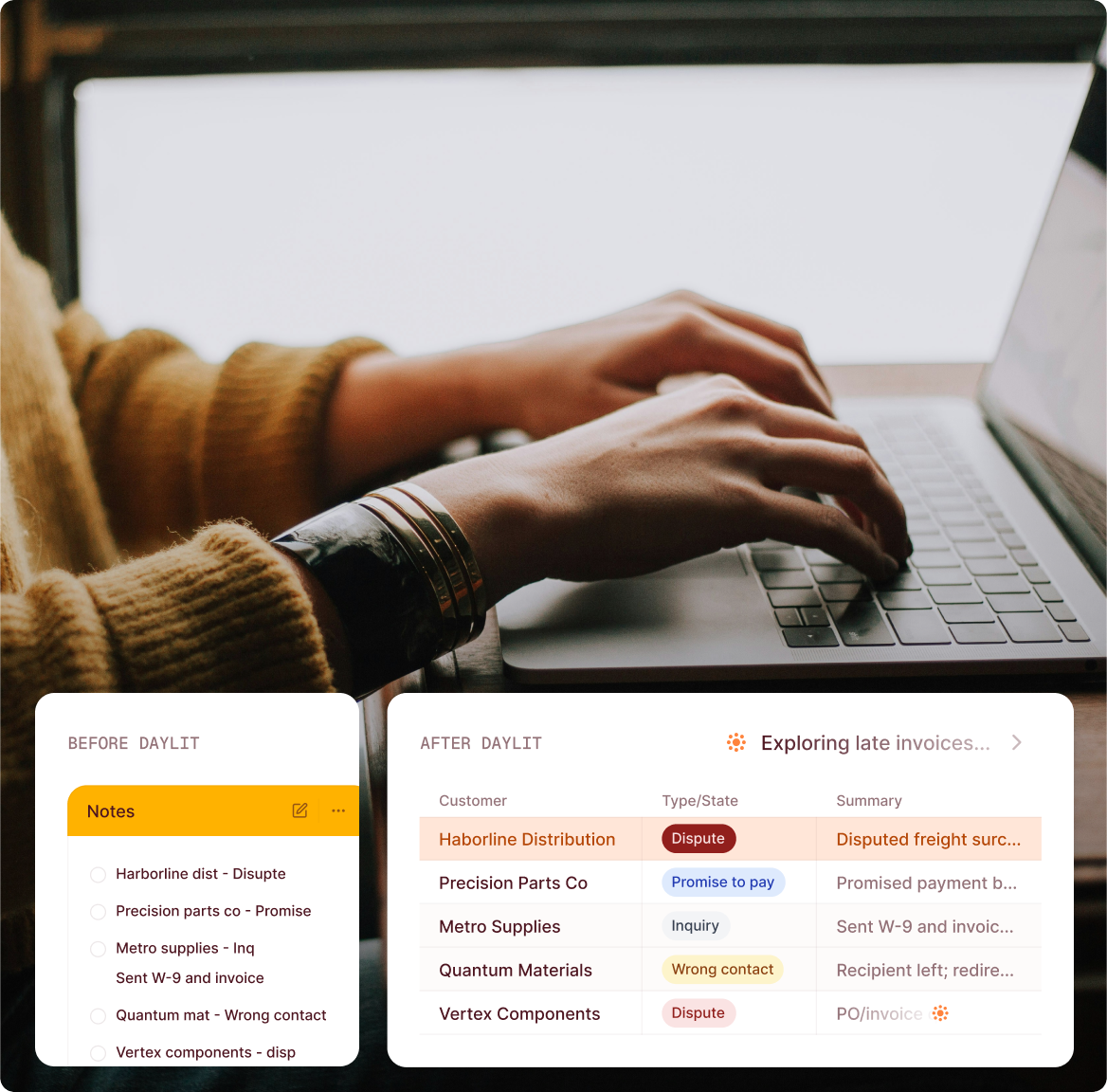
Instead of staffing this problem with more human clerks, businesses are now turning to AI agents to handle the mundane and repetitive tasks for A/R clerks, like responding to customer disputes, reconciling payments, filling out payment portals, and even calling delinquent customers. When trained using the right context - a term used in the AI community to describe the business-specific information provided to the AI software - much of the routine A/R work can be automated. This leaves more time for A/R clerks to handle higher-priority tasks and drive value creation across financial operations.
Investment in AI across accounts receivable picked up in Q4, with several AI startups announcing a total of $195 million in fundraising. Given the massive gap in the A/R workforce and CFOs’ priority in scaling through AI, expect that figure to dramatically increase in 2026 for the betterment of B2B businesses across the country.