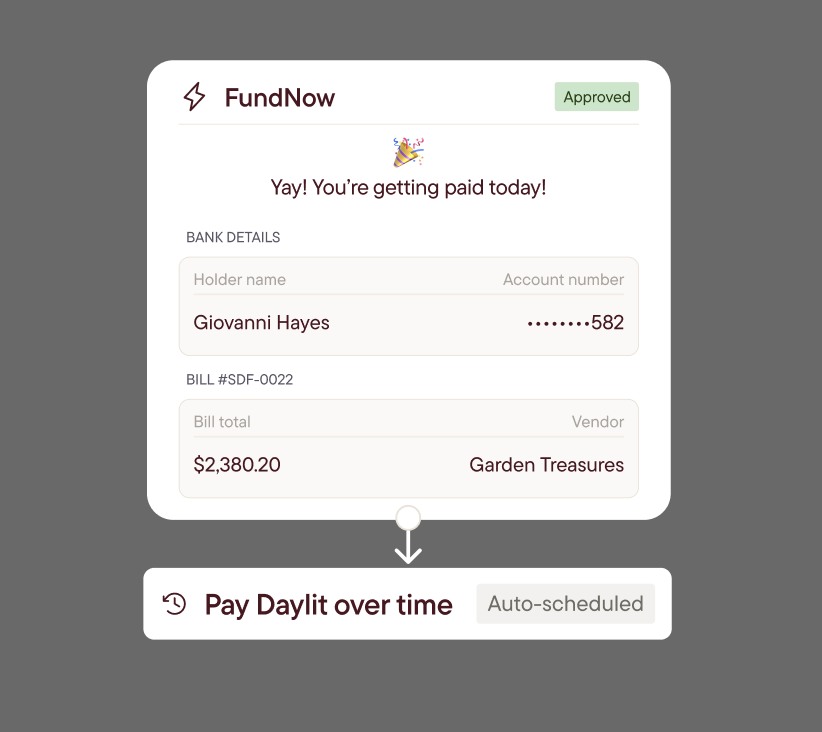
A recent Daylit (formerly Lendica) webinar, led by Daylit’s CEO Jared Shulman, focused on how today’s businesses can prepare for a world of longer payment terms, and how tools like invoice factoring (also known as accounts receivable financing) can turn cash flow management into a strategic advantage.
The Market Is Changing and So Are Payment Terms
According to Daylit’s working capital index, more than half of Fortune 500 companies are expected to request longer payment terms from their vendors soon. This trend is being driven by market slowdowns, delayed customer payments, and slower inventory turnover.
For smaller vendors, this creates a challenge: they need to stay solvent and keep cash flowing even when customers take longer to pay.
Why the Cash Conversion Cycle (CCC) Matters
To handle these shifts, Jared explained the importance of tracking a company’s Cash Conversion Cycle (CCC): the time it takes to turn inventory into cash.
The CCC is made up of three key numbers:
- Days Payable Outstanding (DPO) – how long you take to pay your vendors (higher is better).
- Days Inventory Outstanding (DIO) – how long your inventory sits before it sells (lower is better).
- Days Sales Outstanding (DSO) – how long it takes to collect cash from customers (lower is better).
In simple terms, the formula is:
CCC = DSO + DIO – DPO.
The goal? Shrink your CCC so you get paid faster and keep your cash moving.
What Is Invoice Factoring and How It Helps
One of the most effective ways to reduce DSO is through factoring, also known as advancing payments or advancing receivables.
Factoring lets vendors receive payment earlier by selling their invoices to a financing company. Here are 3 different types of invoice factoring:
- Single-invoice or spot factoring – the simplest, used for one invoice at a time.
- Key account factoring – for all invoices from one customer.
- Total portfolio or asset-backed lending – a full-scale, more complex solution.
For most companies, Jared recommends starting small with spot or key account factoring before scaling up.
{{fundnow-learn-more}}
Picking the Right Invoice Factoring Provider
When choosing a factoring provider, besides the rate and terms, Jared also advised focusing on ease and efficiency. Traditional factoring can involve a lot of manual work and customer interactions, which can slow things down. It’s important to pick a provider which makes factoring “super frictionless,” meaning the process runs smoothly without involving your customers.
Turning Invoice Factoring Into a Sales Advantage
Jared shared a clever example from a manufacturer who used factoring to win more deals.
"They changed their terms from Net 60 to Net 90, but offered a 2% discount if the customer paid within 10 days.
Many buyers took the early payment option, cutting the average collection time by 50 days, and for the rest, the manufacturer used a factoring line to cover the gap.
This creative use of factoring turned a financing tool into a competitive sales strategy."
How to Get Started with Advancing Payments
Jared outlined three practical steps to begin an advancing payments strategy:
- Audit your numbers: Check your DSO, DPO, and DIO to see where cash is getting stuck.
- Start with your slowest accounts: Identify customers with the longest payment terms and test factoring with them.
- Make sure your data systems are ready: Connect your ERP, bank, and invoicing tools for faster offers and tracking.
Try today: Daylit’s “Cash Discovery Wizard”, a simple way to run this first audit automatically.
What Success Looks Like in Advancing Payments
The first metric to watch after implementing an advancing payments strategy is a drop in DSO, which should show up as more cash and fewer receivables on your balance sheet.
Over time, effective factoring can also:
- Increase gross margins (by unlocking supplier discounts)
- Support larger sales (by offering flexible payment terms)
- Reduce bad debt (by staying ahead of credit risk)
Avoiding Common Pitfalls in Invoice Factoring
The biggest mistake? Starting too big. Many companies try to launch large, complex credit lines right away; but Jared’s advice is to start small and stay frictionless. Avoid involving your customers in the process, and work with providers that keep things seamless.
Final Thoughts
As the market shifts and payment terms stretch longer, companies that adapt their cash flow strategies early will have the edge. Whether it’s through invoice factoring or tighter metrics, the key message from the Daylit webinar was clear:
Turn cash flow management into a strategic advantage.
{{fundnow-learn-more}}