Your Cash Forecast Isn’t Broken. It’s Guessing.

Aging reports treat every promise to pay the same. Here's how Cash Flow Forecast weights each invoice by actual payment history instead — and adjusts the moment a promise or dispute comes in.

Jared Shulman
August 31, 2026

Your Cash Forecast Isn't Broken. It's Guessing.

A Promise to Pay Isn't a Forecast

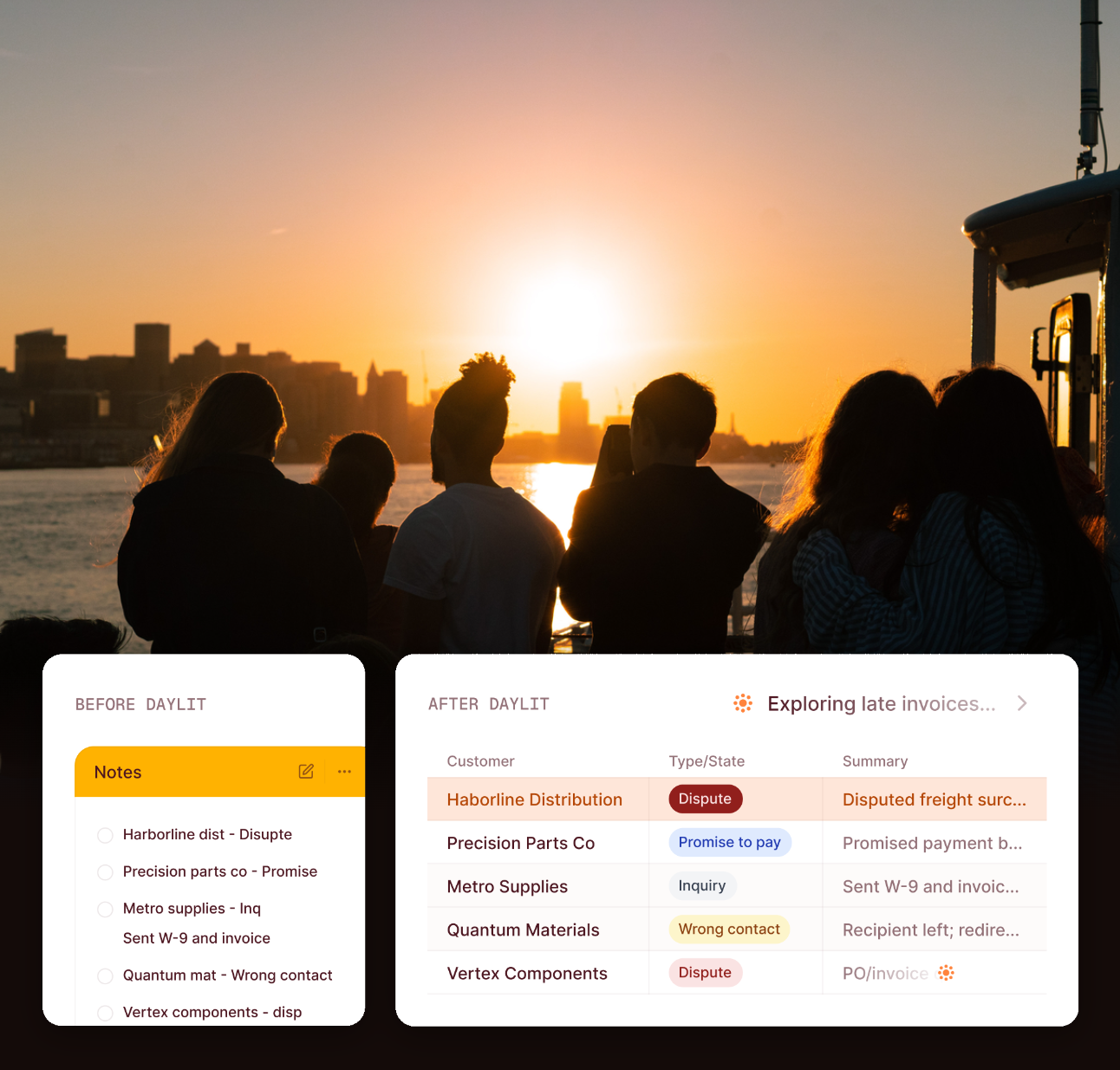
Every AR team already knows how to build a cash forecast. That's not the problem. The problem is what that forecast is actually made of: an aging report, discounted by the same generic guess for every invoice in a bucket, whether it's from a customer who's paid on time for two years or one who's constantly ghosting your follow-ups. Both invoices sit in the same column. Both get treated the same. Neither is actually the same risk.

That gap between the invoice and the guess doesn't show up right away. It shows up in DSO — and not because a worse forecast makes DSO worse. DSO is driven by how customers actually pay, not by how well you predicted it. What a guessed forecast actually costs you is warning time: you don't see DSO trouble coming, you just find out about it after the fact, at the same moment everyone else does. And when the accuracy is off in the wrong direction, that shows up somewhere more expensive — credit lines pulled too early, or not pulled early enough, either way costing real interest.

A promise to pay isn't a payment. Most forecasts treat it like one anyway — ours doesn't.

Why a Bigger AR Book Makes Guessing Worse, Not Better

The bigger the book, the worse this gets, not better. A hand-built spreadsheet forecast works fine when there are a few hundred open invoices and one person who knows every account by memory. It stops working the moment the book outgrows any one person's memory — hundreds of promises, a rotating set of disputes, invoices that haven't even been billed yet, all needing to be weighed by hand, every single week.

Teams don't fall behind on rebuilding the forecast because they're not careful enough — they fall behind because the number of judgment calls has outgrown what a spreadsheet, or a person, can carry manually. AR automation closes that gap the same way it closes others: not by adding headcount, but by giving the team back the hours they were spending rebuilding the same guess every week.

Weighting Every Invoice by What History Actually Says

Cash Flow Forecast gives you a 13-week, week-by-week view of expected AR collections — refreshed every night. Every invoice starts with a baseline weighted two ways: your whole book's aging-bucket history, and that specific customer's own payment pattern. Not aging bucket alone, applied the same to every account — a customer who typically pays 17 days late gets weighted like a customer who typically pays 17 days late, not folded into a flat 31–60-day guess with everyone else. A forecast built only on that baseline still has a blind spot: it can't see what's changed since the aging report was pulled. That's why our model takes into account live signals, with an AI layer that reads incoming emails for promise-to-pay and dispute activity and shifts the affected invoice's predicted date accordingly.

It doesn't stop at invoices you've already billed, either. The forecast also estimates invoices you haven't sent yet, based on your own billing cadence and seasonality — so the 13-week view isn't just what's already sitting in AR, it's what's coming too.

When a Promise or Dispute Changes the Math

A forecast that only updates once a month isn't much better than a spreadsheet. So the moment a promise-to-pay or a dispute comes in, the forecast adjusts — logged manually by your team, or picked up automatically by the AI layer. Spotted, shifted, and reflected in the 13-week view, the same day.

Even with the AI layer, that doesn't change who's actually running the case. A promise or dispute moves the forecast's math — it doesn't move the decision. Your team still owns the call on which case gets worked and when; the forecast just makes sure that call is informed by the latest signal instead of one that's stale.

How Cash Flow Forecast Works in Daylit, End to End

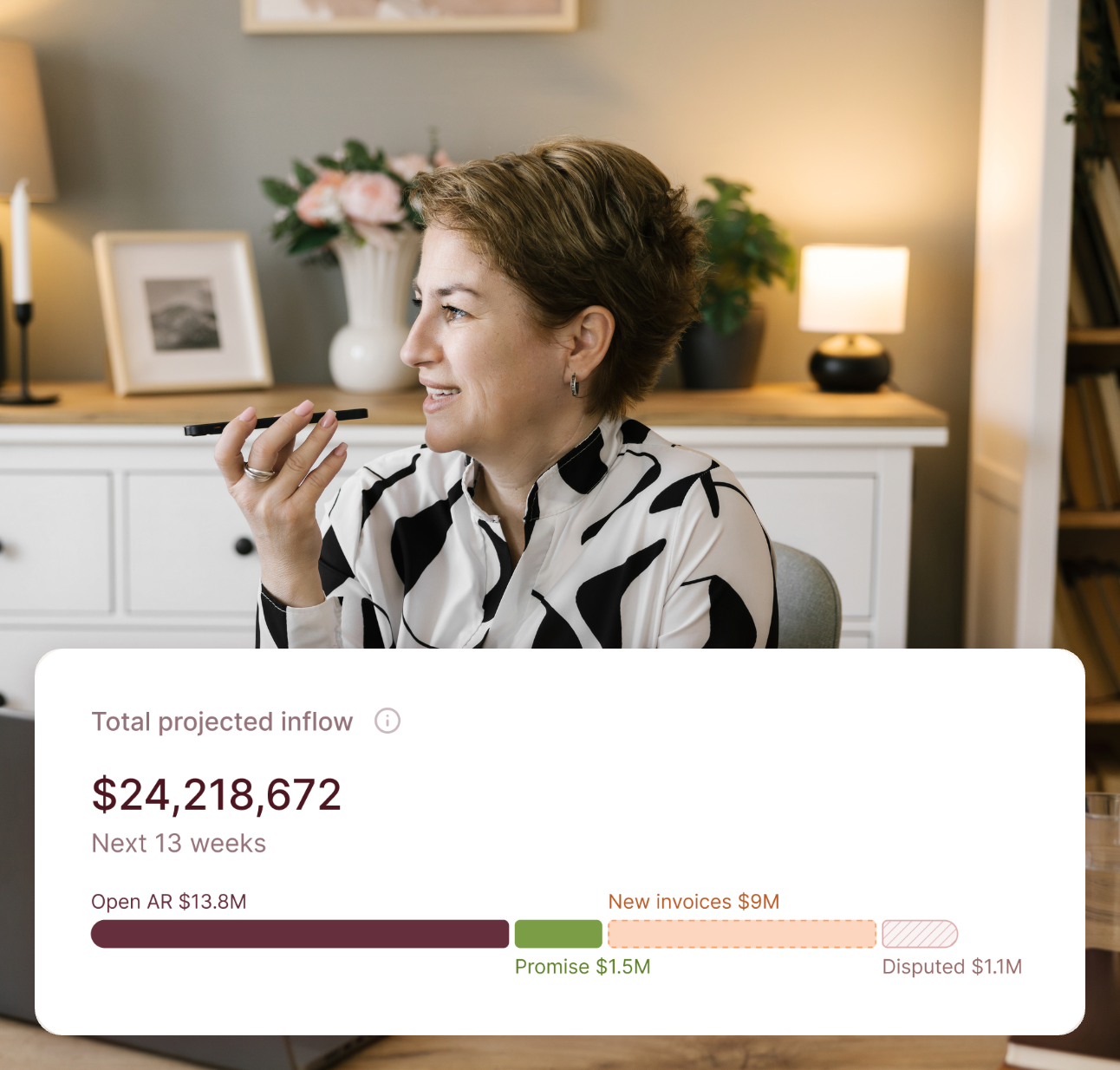
Open the 13-week view and every invoice is already broken out for you: expected cash from what's already open, promise cash from what's been committed to, disputed cash set aside on its own, and projected cash from invoices you haven't even billed yet — one view instead of four separate mental tallies. A view toggle lets you flip between what's expected, the full balance, and what would come in if every invoice paid exactly on time, without rebuilding the math three different ways yourself. Disputed cash stays visible but out of the total until it's actually resolved, so the number you're planning around is already the conservative read, not the optimistic one.

Click into the customer-by-week breakdown and you can see exactly which accounts are actually driving next week's number — not a portfolio total, but the specific customers behind it. And underneath all of it, the forecast tracks its own prediction miss and recalibrates automatically — a forecast that visibly corrects itself is a much easier thing to trust than a black box that just asserts a number.

Want to see which of your customers' promises would actually hold up?

We’ll walk your open AR with you and show you exactly what’s confident, what’s just due, and what’s at risk.

Book a Meeting

From One Invoice to a Portfolio You Can Trust

This doesn't just matter at the level of one invoice. It's the difference between a portfolio total nobody quite trusts and one you can actually stand behind. The customer-by-week breakdown means collections effort gets pointed at the accounts actually moving this week's number, not spread evenly across the whole book out of habit. Disputed cash is already excluded from the total, not something you have to remember to strip out — so when someone asks for the conservative read, you're already looking at it, not building it from scratch.

No more guessing. Just the forecast, on demand. That's the whole point of weighting it by what history actually says instead of what an aging report assumes.

Conclusion

Most cash forecasts are aging reports wearing a confident label. They treat every promise the same because that's all a spreadsheet can do at scale. Then the team pays for that flattening later, in write-offs, in credit lines pulled at the wrong moment, in a DSO number nobody saw coming. Cash Flow Forecast doesn't ask you to trust a black box instead. It weights every invoice by your book's history and that specific customer's own pattern, adjusts the moment new information comes in, and shows its own accuracy back to you. Every customer pays differently. This is what it looks like to build that in.

Frequently Asked Questions

Does Cash Flow Forecast include what we owe, not just what's coming in?

No — this is AR collections only. It forecasts inflows, not a full net-cash-flow view, so it can't net what's coming in against what you owe. That was a deliberate scope decision for this release, to keep the first version focused entirely on AR.

Will this replace the forecast spreadsheet I've already built?

Not automatically. Cash Flow Forecast is a new, independent 13-week view built entirely from the AR data already syncing into Daylit — it doesn't import your spreadsheet or carry over any manual adjustments you've built into it over time. If your spreadsheet has hand-tuned logic like "this customer always pays late, so I discount them further," that logic only shows up in the new forecast once it's captured as an actual promise-to-pay or dispute case. You can still download the forecast out of Daylit to feed downstream models.

How does the prediction model actually work?

Every open invoice starts with a baseline weighted two ways: your whole book's aging-bucket history, and that specific customer's own payment pattern. From there, the forecast adjusts the moment a promise-to-pay or dispute comes in — logged manually, or picked up automatically when our AI reads an incoming email about it.

Insights

You might also like...

Why Your AR Customer Segmentation Is Always Out of Date (And What to Do About It)
Manual tags go stale the moment anything changes about a customer. Here's why re-tagging never actually gets done at scale — and what it looks like when segmentation stays accurate on its own.
Read more
Why Your AR Customer Segmentation Is Always Out of Date (And What to Do About It)
Accounts Receivable Automation
Your Finance Team Has a Copy-Paste Budget. Nobody Approved It.
A copy-and-paste budget doesn't sound like much — until you put a number on it. 131 hours a week, roughly $300,000 a year, nearly half of it stuck in collections and disputes. Why the function never gets fixed on its own, and what to count before you hire more headcount.
Read more
Your Finance Team Has a Copy-Paste Budget. Nobody Approved It.
Report
The Slowest Part of a Dispute Isn't the Customer — It's the Manual Work
Collection Cases standardizes how AR teams handle disputes, promises to pay, and inquiries. Instead of each case depending on who opens it, every case type gets a default sequence with an AI-suggested next step your team confirms with one click.
Read more
The Slowest Part of a Dispute Isn't the Customer — It's the Manual Work
Accounts Receivable Automation
No items found.